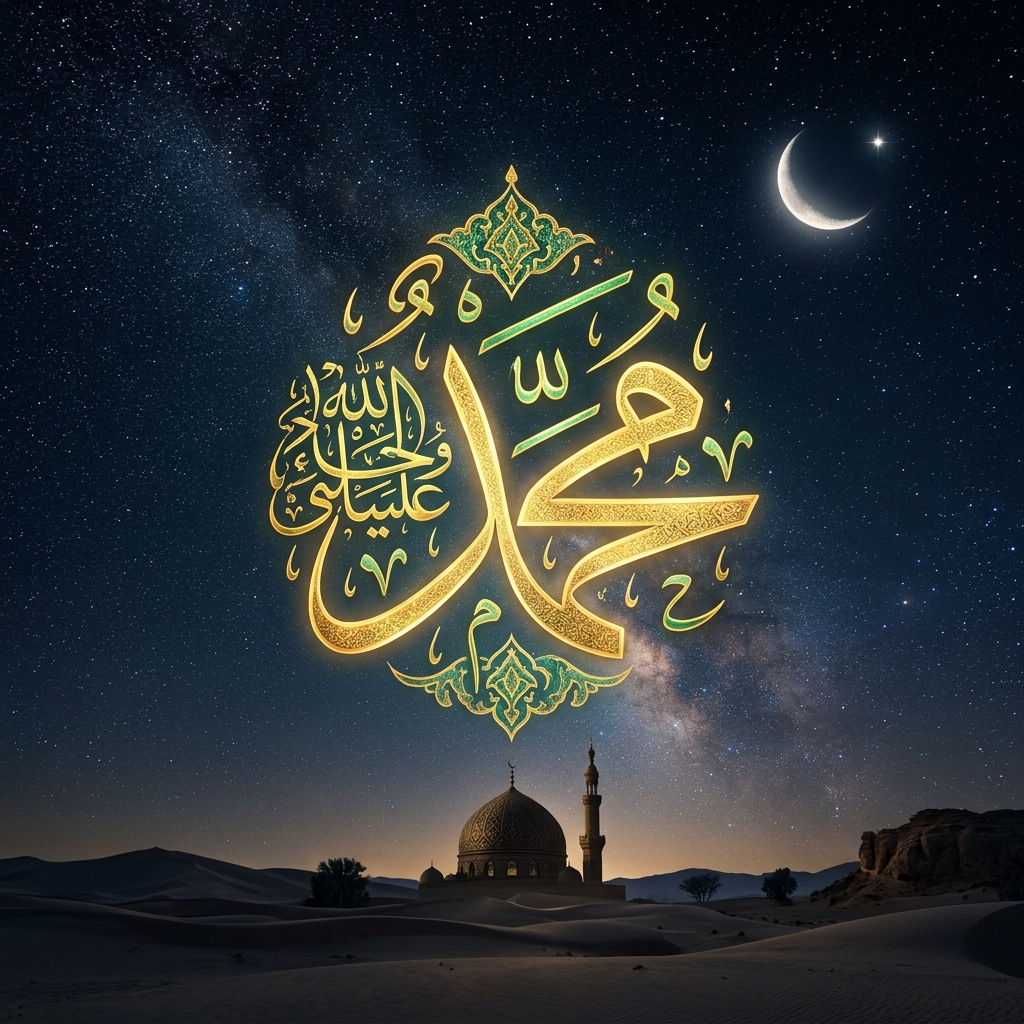
Prophet Muhammad صلى الله عليه وسلم: The Final Messenger and Seal of Prophets
The Ultimate Guide to the Life, Character, and Eternal Legacy of the Mercy to All Worlds
Essential Takeaways
- Character First: His reputation as Al-Amin (The Trustworthy) was established long before Prophethood.
- Social Justice: The message of Islam dismantled racial and tribal hierarchies.
- Mercy to All: His compassion extended to enemies, animals, and the environment.
- Living Example: The Sunnah provides a practical blueprint for every aspect of human life.
Introduction: The Most Influential Man in History
The life of Prophet Muhammad صلى الله عليه وسلم is not merely a chapter in history; it is the definitive guide for human excellence. Cited by historians like Michael H. Hart as the single most influential person in human history, the Prophet صلى الله عليه وسلم achieved unparalleled success in both religious and secular domains. Born in the rugged terrain of Makkah, he rose to transform a fragmented, warring society into a unified civilization based on justice, monotheism (Tawhid), and compasson.
This 3500-word biography explores the profound journey of the Final Messenger of Allah, from his orphan childhood to his role as the architect of a global faith. Whether you are a student of history, a seeker of truth, or a believer looking to deepen your love for the Messenger صلى الله عليه وسلم, this comprehensive study provides the insights needed to understand the "Mercy to All Worlds."
Pre-Islamic Arabia: The Age of Ignorance (Jahiliyyah)
To appreciate the magnitude of the Prophet's صلى الله عليه وسلم mission, one must understand the state of the world into which he was born. 6th-century Arabia was defined by Jahiliyyah—a term meaning ignorance, but specifically referring to a lack of moral and spiritual direction. The Arabian Peninsula was dominated by tribalism, where blood feuds lasted generations and the strong exploited the weak.
Idolatry was rampant, with 360 idols placed around the Ka'bah, the house built by Prophets Ibrahim عليه السلام and Ismail عليه السلام for the worship of the One God. Socially, the era was dark; female infanticide was common, women had few rights, and slavery was brutal. Intellectual life was limited to poetry, while spiritual life was a chaotic mix of paganism and superstitions. It was into this moral vacuum that the Seal of Prophets was sent to restore the pure monotheism of his ancestors.
Noble Lineage and the Year of the Elephant
The Prophet Muhammad صلى الله عليه وسلم was born into the most noble clan of the Quraysh—the Bani Hashim. His lineage traces directly back to Prophet Isma'il عليه السلام and Prophet Ibrahim عليه السلام, fulfilling the ancient prayers for a Messenger to be sent among the Arabs. His father, Abdullah, was known for his radiant character and beauty, but he passed away in Yathrib shortly before Muhammad صلى الله عليه وسلم was born.
His birth in 570 CE, the "Year of the Elephant," was marked by extraordinary events. When his mother Aminah was pregnant, she described seeing a light that reached the palaces of Busra in Syria. Upon his birth, his grandfather Abdul Muttalib took him to the Ka'bah and named him Muhammad—a name meaning "The Praised One"—expressing his hope that the heavens and earth would praise his grandson.
Divine Protection: The Early Years
The early life of the Prophet صلى الله عليه وسلم was characterized by a series of losses that fostered complete reliance on Allah. After his mother’s death when he was six, and his grandfather’s two years later, he was raised by his uncle Abu Talib. Despite the lack of parental support, he was divinely protected from the vices of Makkan society. He never bowed to an idol, never drank wine, and never uttered a lie.
Working as a shepherd in his youth taught him the essential Prophetic qualities: patience, vigilance, and the ability to guide a flock with compassion. These years in the quiet pastures of Makkah allowed for deep spiritual reflection, far removed from the materialistic distractions of the city.
Al-Amin: The Foundation of Integrity
By the age of twenty-five, Muhammad صلى الله عليه وسلم was the most respected man in Makkah. He was universally titled Al-Amin (The Trustworthy) and As-Sadiq (The Truthful). This reputation was not just a title; it was a reality that meant even his enemies would entrust him with their most precious belongings. His integrity was remarkably displayed during the reconstruction of the Ka'bah when he resolved a tribal conflict regarding the placement of the Black Stone (Hajar al-Aswad) with a simple, brilliant act of diplomacy that satisfied every clan leader.
The Call of Prophethood: The Cave of Hira
Spiritual yearning led him to the solitude of the Cave of Hira on Mount Noor. It was here, in 610 CE, that the Archangel Jibreel appeared with the first command of the Final Revelation: "Read! In the name of your Lord who created..." (Surah Al-Alaq). This moment of cosmic significance marked the end of the long silence between Heaven and Earth and the beginning of the final chapter of Divine Guidance.
Overwhelmed by the majesty of the experience, he sought comfort from his wife Khadija رضي الله عنه, who was the first human to recognize his Prophethood. Her support, along with the early conversion of Ali رضي الله عنه, Abu Bakr رضي الله عنه, and Zayd رضي الله عنه, formed the initial core of the Ummah that would eventually grow to billions.
The Makkan Struggle: Courage Against All Odds
For thirteen years in Makkah, the Prophet صلى الله عليه وسلم and his followers faced relentless persecution. The message of Tawhid (Monotheism) threatened the socio-economic structure of the Quraysh, who responded with boycotts, torture, and eventually assassination plots. Through it all, the Prophet صلى الله عليه وسلم remained a pillar of steadfastness (Sabr). He taught his companions that the strength of faith is greater than any physical tyranny.
The Year of Sorrow brought the loss of his two greatest earthly supporters: Abu Talib and Khadija رضي الله عنه. Yet, even when he was rejected and pelted with stones at Ta'if, his response was a prayer for mercy: "O Allah, I complain to You of my weakness... If You are not angry with me, I do not care [about anything else]." This profound humility is the essence of Prophetic character.
Al-Isra' wal-Mi'raj: The Celestial Journey
In his moment of greatest earthly grief, Allah invited His Messenger صلى الله عليه وسلم on a journey beyond space and time. The Night Journey from Makkah to Jerusalem and the Ascension through the seven heavens was a divine validation. He led all the Prophets in prayer at Masjid al-Aqsa and stood at the Sidrat al-Muntaha (The Lote Tree of the Utmost Boundary), receiving the gift of the five daily prayers (Salat) for his Ummah.
The Hijra and the Architecture of a Just Society
The migration to Madinah in 622 CE was not a flight from fear, but a strategic transition to build a model society. In Madinah, the Prophet صلى الله عليه وسلم established the Charter of Madinah—the world's first written constitution that guaranteed religious freedom and social justice for Muslims, Jews, and other groups alike. He built the Masjid an-Nabawi as a center for worship, education, and governance, proving that spirituality and social life are inseparable.
His reforms were revolutionary. He abolished usury, established women's rights to inheritance and education (unheard of in that era), and created a welfare system where the wealthy were responsible for the poor. The Mu'akhah (Brotherhood) he established between the Migrants (Muhajirun) and the Helpers (Ansar) is the greatest example of social cohesion in human history.
Shamail: The Sublime Physicality and Manners
To know the Prophet صلى الله عليه وسلم is to understand his Shamail—his physical description and daily manners as recorded by his closest companions. He was of middle height, with a radiant complexion often described as "white mixed with redness." His hair was wavy and black, and his eyes were large, dark, and filled with deep compassion. When he walked, it was with a firm, energetic gait, as if he were descending a slope.
His speech was deliberate, clear, and never spoken in vain. He was the most generous of people, yet he lived with extreme simplicity. His bed was a simple mat of palm fibers that left marks on his side. He would mend his own shoes and patch his own clothes, demonstrating that true greatness lies in humility. He was always the first to greet others, especially children, whom he treated with immense tenderness.
The Prophetic Day: A Life of Worship and Service
The daily routine of the Prophet صلى الله عليه وسلم was a perfect balance of devotion and service. He would spend the late hours of the night in Tahajjud, weeping in prayer until his feet swelled, out of pure gratitude to Allah. After Fajr, he would sit with his companions, teaching them, interpreting their dreams, and inquiring about their well-being. He was a father to the orphans and a protector of the widows.
He was known to be "more bashful than a virgin in her veil," yet in the face of injustice, he was the bravest of men. In the heat of battle, his companions would seek refuge behind him. His character was the Quran itself in motion; his wife Aisha رضي الله عنه famously said: "His character was the Quran."
Mercy to All Worlds: Ethics in Conflict
Even in war, the Prophet صلى الله عليه وسلم was a teacher of ethics. He forbade the killing of women, children, and the elderly. He prohibited the destruction of trees, the killing of animals for sport, and the harming of monks in their cloisters. His standard of warfare was not conquest, but the restoration of justice. The Conquest of Makkah in 8 AH remains the most peaceful conquest in history. Standing before his former persecutors, he announced a general amnesty: "Go, for you are all free." This act of mercy transformed his enemies into his most ardent followers.
The Greatest Miracle: The Eternal Quran
While other Prophets were given physical miracles limited to their time, Prophet Muhammad صلى الله عليه وسلم was given the Quran—the living miracle. Its linguistic perfection, scientific accuracy, and accurate historical and future prophecies continue to challenge humanity. He taught that the Quran is a "Healing and a Mercy," a guide that speaks to the intellect and the heart simultaneously.
The Farewell Pilgrimage: A Universal Declaration
In his final Hajj, the Prophet صلى الله عليه وسلم delivered the Farewell Sermon to over 140,000 pilgrims. He declared the absolute equality of all races: "An Arab has no superiority over a non-Arab, nor does a non-Arab have any superiority over an Arab... except by God-conciousness (Taqwa)." He affirmed the sanctity of life, property, and the rights of women, leaving a timeless manifesto for human rights.
The Final Departure and the Eternal Light
The Prophet صلى الله عليه وسلم passed away in 632 CE (11 AH) in the city of Madinah. His death left the companions in profound shock, but his mission was complete. He had established a faith that would spread to every corner of the globe. He left behind the Quran and his Sunnah as two weights that would prevent the Ummah from going astray.
Today, the legacy of Prophet Muhammad صلى الله عليه وسلم lives in the hearts of billions. His name is praised in every corner of the earth five times a day during the Adhan. His teachings on science, environment, social justice, and personal ethics are more relevant now than ever. He is the Seal of Prophets, the final link in the chain of Divine guidance, and the Mercy that never ends.
"And We have not sent you, [O Muhammad], except as a mercy to the worlds."
— Quran 21:107"None of you truly believes until I am more beloved to him than his father, his children, and all of mankind."
— Sahih BukhariMaster the Seerah of the Prophet صلى الله عليه وسلم
Our premium 'Life of the Prophet' course offers an academic yet deeply spiritual exploration of the Seerah. Under the guidance of expert scholars, journey through the life of the greatest man to walk the earth.